Your trusted GoHighLevel developer and agency partner.
I'm Gareth. I implement GoHighLevel, onboard agency clients through the API, and customise the CRM so it matches how they sell. HighLevel is the same product under a shorter name. Broken accounts still get taken, but the work still starts with how it should run.
Tired of being bombarded with cold pitches from strangers?
Trust matters. I'm not an agency with a sales team. I'm the person who does the work, and the person who answers the phone. HighLevel verified me as a Developer Partner, certified me as an Admin, and every review on the directory is five out of five.
Book a call and you work with the team you can rely on: me.
HighLevel (GoHighLevel, GHL) is where every conversation with a customer should land: phone, SMS, email, web chat, social, booking, payments. One contact record, one inbox, one place your team and your automations can see the full thread. That is the hub.
Built into that hub is conversational AI: Voice AI on the phone, Conversation AI in the inbox, agents that can book, tag, route and follow up on the same record your staff use. Not a chatbot bolted onto a CRM. Intelligence native to the platform.
Through the API, webhooks and MCP, almost anything we can integrate with can be brought into HighLevel, your website, your ad platforms, your accounting, your legacy database, whatever has a door. The platform becomes the bridge between those systems and your people.
Once the data is here, you apply logic to it: workflows for the repeatable rules, AI for the judgment calls. Data flows in, the platform decides, humans step in when they should. That architecture is my whole job, wire the systems in, make the logic hold, keep the handoffs clean.
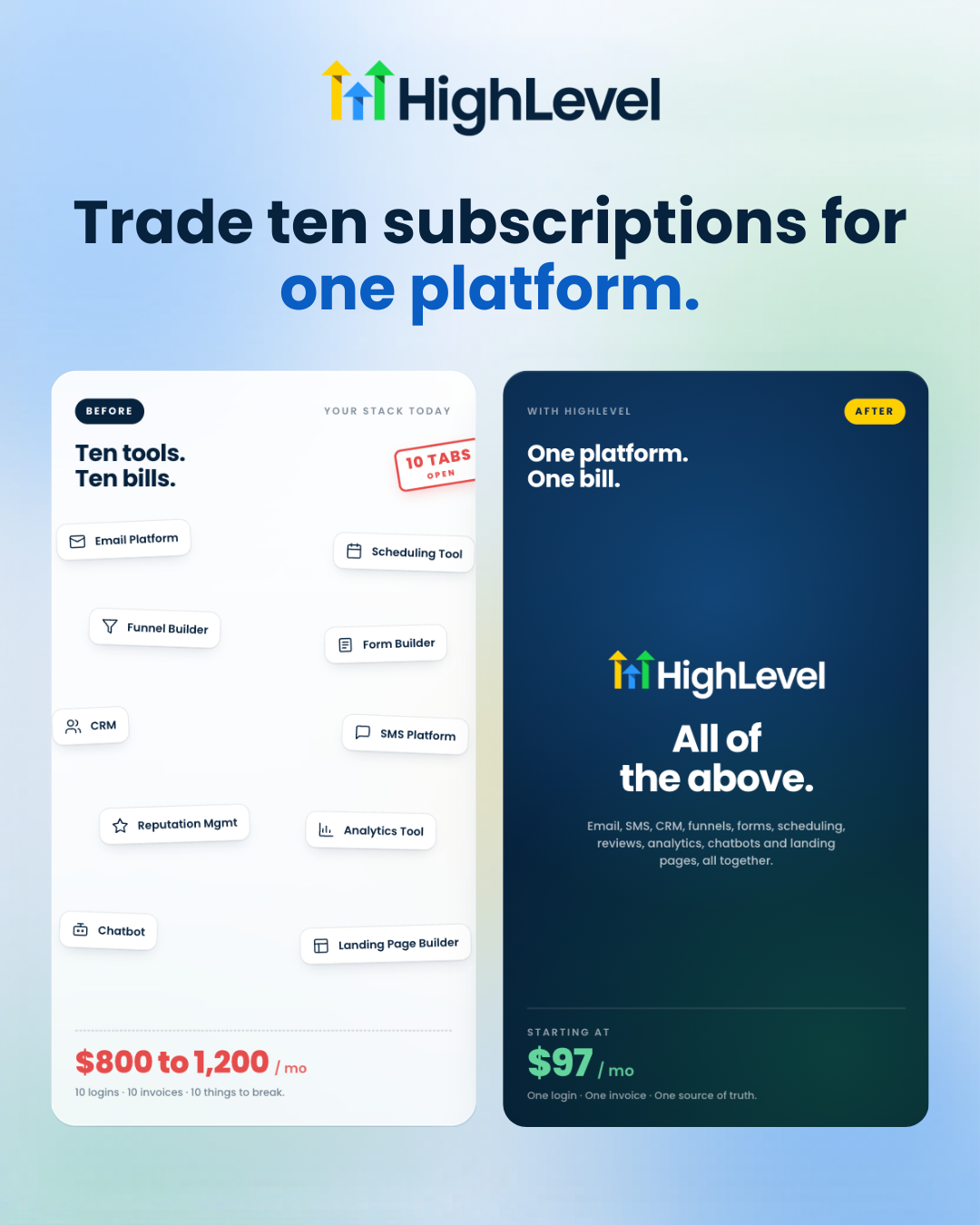
HighLevel's own maths: ten logins, ten invoices, ten things to break, against one platform from $97 a month.
Why I see it this way
I've been building this architecture my whole career
I've worked in information and communications technology since I was eighteen. IT first, then infrastructure as a service, then trading infrastructure, the networks and connectivity that financial markets run on. Then back into unified communications and collaboration, which was integrations again: voice, messaging, presence, all wired into the tools people actually use.
One of my first jobs in the City was selling NICE contact centre technology for financial services. Recording, compliance, routing, handoffs between systems and people, the same problems HighLevel solves today, without a six-figure implementation and an eighteen-month project plan.
When I look at HighLevel, I don't see a CRM with features bolted on. I see a communications hub, the thing I've spent twenty-five years building for banks and enterprises, now available to a business from ninety-seven dollars a month. The API and MCP bring in whatever else you run. Workflows and AI apply the logic once it's here.
That's why I think it's the best platform on the planet, and why I'm probably well placed to say so. The full story →
Why I think it's the best CRM and business operations platform on the planet
I'm not saying that because I sell it. I'm saying it because I've spent twenty-five years building phone systems, contact centres and integration layers for organisations including HSBC, RBS, Citibank and Goldman Sachs, and HighLevel is the first platform that puts all of that in one place. This is the list that keeps me here.
01
One contact record, everywhere
The call, the text, the email, the form fill, the invoice and the booking all land on the same contact. No Zapier duct tape between a CRM, an email tool and a phone system that each hold a different version of the truth.
02
It replaces the stack
CRM, funnels, booking, SMS, email, phone, reviews, payments, courses. Businesses routinely cancel five or six subscriptions after moving in, and the monthly saving often covers the platform several times over.
03
AI built in, not bolted on
Voice AI answers the phone, Conversation AI works the inbox, and agents act on the same contact record as your staff. Because it lives inside the communications hub, AI can book, tag, route and hand off to a person, not just chat in a sidebar.
04
A real developer platform
The API, webhooks and MCP mean you can bring almost any system into HighLevel, not just the ones with a native integration. Wire it in, then apply logic through workflows and AI. Most platforms at this price point are a walled garden; this one has doors.
05
White-label SaaS mode
An agency can resell the entire platform under its own brand, with its own pricing and rebilling. Your clients get software with your name on it; you get recurring revenue that isn't tied to your hours.
06
Relentless shipping
The platform ships meaningful features weekly. That pace is why it keeps lapping competitors, and it's also why accounts need someone watching the changes. Both halves of that sentence are true.
Full disclosure: the links below are affiliate links, so if you start an account through one I may earn a commission. It costs you nothing extra and it doesn't change what I've written above. I pay for my own HighLevel licences like everyone else.
Getting started on the platform
Not on HighLevel yet? Start with a trial, not a migration
HighLevel gives you a free trial, and a trial account is enough to answer the only question that matters: does this replace what you're paying for now. Build one pipeline, connect one calendar, send one campaign. You'll know within a fortnight.
Plans run from a single-business account through an agency plan with unlimited sub-accounts, up to the tier that unlocks SaaS mode so you can resell the platform under your own brand. Most operators start one tier below where they end up, which is fine: upgrading is a click, and nothing is rebuilt.
How to find what you need in the HighLevel ecosystem
The platform ships fast and the ecosystem around it is enormous, which means the answer to almost any HighLevel question already exists somewhere. The difficulty is knowing which door to knock on. This is the map I'd give a new operator, in the order I'd use it.
The certifications
HighLevel runs an examined Certified Admin programme, plus a growing set of skills badges per feature area: AI Voice, A2P, HIPAA, Meta and paid ads, funnels, courses, social, and more. Each is an assessment, not a download. If you're hiring, ask which badges someone holds and check them on the directory rather than taking a CV's word for it.
I hold the Certified Admin credential and twelve skills badges. They're all shown further up this page, each linking to the directory.
The community groups
The official HighLevel user community is the busiest room in the ecosystem, and there are focused groups around SaaS mode, agency operations, AI and voice, and developers building on the API. Search before posting; most questions have been answered three times this month. The developer side is where the genuinely hard answers live.
Rule of thumb: community for "how do people usually do this", support for "this is broken", a developer for "the platform won't do this at all".
Official support and docs
HighLevel's help centre, live chat and 24/7 support handle account, billing and platform faults. The developer documentation covers API v3, OAuth, webhooks and the Marketplace. The ideas and product boards are where feature requests get voted on, and the release notes tell you what changed this week, which matters more than most people realise.
If a support ticket keeps bouncing, it's usually because the request needs development rather than configuration. That's the point at which people call me.
Events, summits and the Marketplace
HighLevel runs regular summits and community events, online and in person, and the Marketplace is where third-party apps, snapshots and services are listed. Between them they're the fastest way to see what's actually working for other operators rather than what's being marketed at you.
I build on the Marketplace side as one of seven Verified Developer Partners, and I'm at the events. Worth saying hello.
The platform under your data is audited, certified and awarded
If a client's procurement team, a regulator or a cyber-insurance form ever asks where your customer data lives, HighLevel has real answers. This is the part of the platform nobody shows in a demo, and the part serious buyers ask me about most. All of it is checkable on HighLevel's public trust centre, not just claimed on a sales page.
SOC 2 TYPE II
Audited annually, not once
Independent yearly audits against the AICPA's standards for security, availability and confidentiality. Type II means the controls were tested over months of live operation, not described in a document.
The global benchmark for information security management, held through external audit. The certificate itself sits on the public trust centre, downloadable alongside the SOC 2 attestation report.
Certified under the EU-U.S. Data Privacy Framework for lawful data transfer, compliant with GDPR, CCPA and CAN-SPAM, with in-platform tools for consent, data access and deletion requests. UK businesses: this is the section your DPO wants.
Protected Health Information handled with enterprise-grade encryption, and HighLevel signs Business Associate Agreements. HIPAA readiness is configured per account, which is exactly the kind of work I'm hired for.
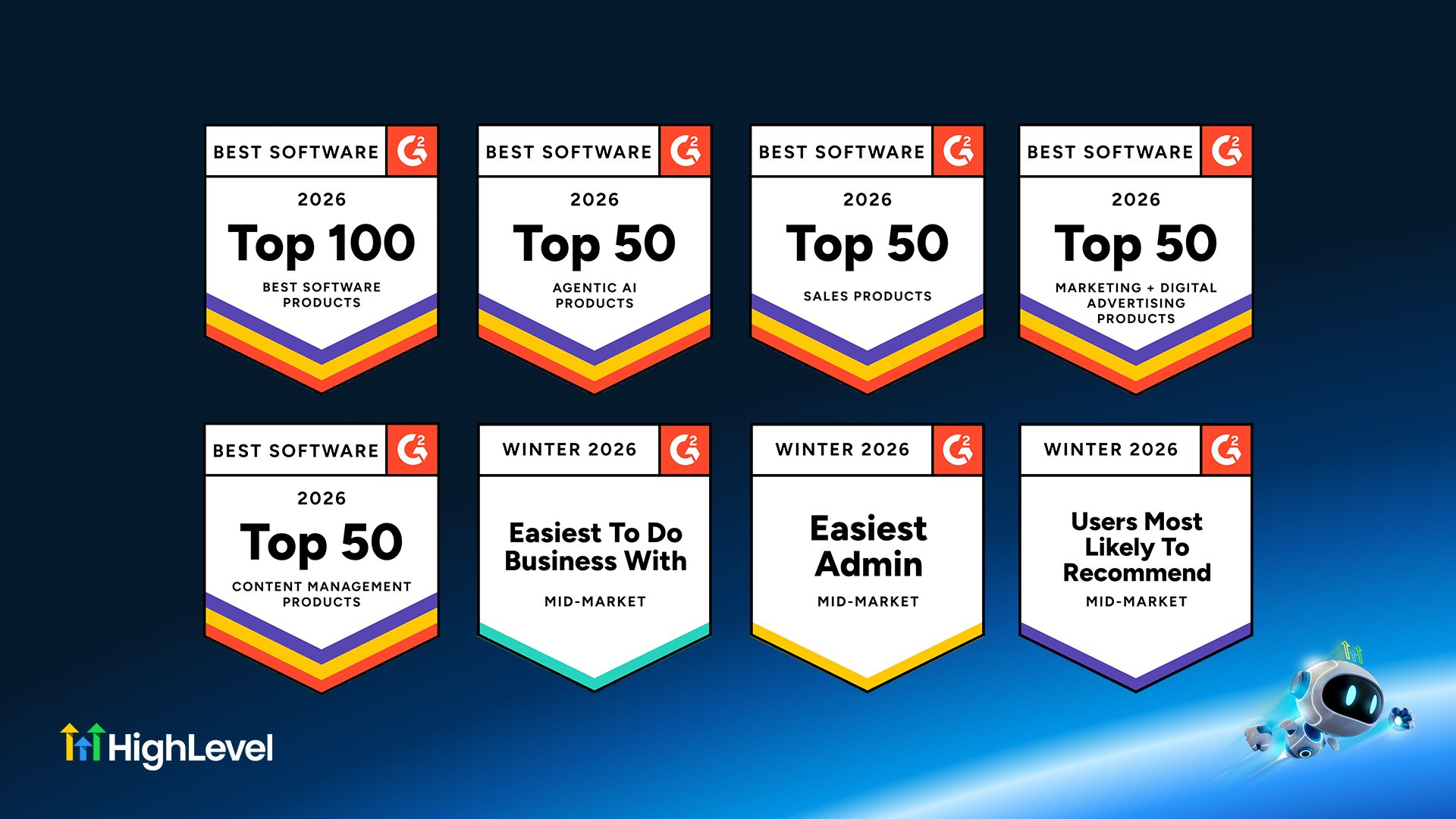
Badge artwork from HighLevel's official G2 announcement.
And the recognition to go with it
G2 Best Software Awards 2026: ranked #81 on the Top 100 Best Software Products list, from verified customer reviews, and named across five category lists including Marketing & Digital Advertising, Sales and Agentic AI.
Deloitte Technology Fast 500, 2025: named among the fastest-growing technology companies in North America.
SMU Cox Dallas 100: #4 fastest-growing private company in North Texas.
Over a million businesses now run on the platform, by HighLevel's own count in that announcement.
The honest caveat: certification covers the platform, not your account. Two-factor enforcement, user permissions, audit logs and consent tooling all exist, but they're switched on and scoped per account, and most accounts I audit have at least one of them wrong. Checking that is part of the free audit.
LevelUp, HighLevel's annual conference: go once and the platform makes sense
LevelUp is the one room where the whole ecosystem stands together. The 2025 edition ran for three days at the Dallas Hilton Anatole: over a thousand agency owners, operators and SaaS founders, the 2026 roadmap unveiled from the main stage with more than 300 new features, breakout tracks run by the people who built them, and the first black-tie awards gala. It is where I've had half my best technical conversations, and where the platform's direction stops being rumour and becomes a roadmap you've heard first-hand.
The roadmap, first-hand
Product announcements land on the LevelUp stage before they land anywhere else. Knowing what ships next quarter changes what you build this quarter.
The room itself
Thousands of operators who run the same platform you do. One corridor conversation about how someone else solved your exact problem pays for the ticket.
Workshops and certification
Hands-on sessions run by the people who built the features, and the chance to sit certifications in person rather than at a distance.
Marketlinx CRM is my own SaaS product, built on HighLevel and sold under my brand. Underneath it is the platform I've just spent a page recommending, so nothing about it is a compromise: same CRM, same automation engine, same AI, same phone system. On top of it sits the work I'd otherwise be billing for, already done.
That means my own Marketplace apps included rather than quoted: Front Desk Assist so no missed call or due follow-up goes unworked, the provisioning console so a new account is configured in an afternoon rather than a fortnight, and the integration layer so the CRM talks to whatever else you run. It means an account that arrives architected, with pipelines, fields and lifecycle stages that match a real business instead of a snapshot's guess.
And it means the person who built it answers the phone. Not a support queue, not a chatbot: the developer who wrote the code, who knows what changed in the platform this week and what it means for your account.
•Front Desk Assist included: one inbox for missed calls, unread messages and due follow-ups
•Architected account: pipelines, custom fields and lifecycle stages built around your business, not a template
•Provisioning: staged, reviewable setup with every change logged and reversible
•Voice AI and agents deployed against your real call flow, with escalation to a human
•Integration layer: APIs and MCP servers that bring external systems into HighLevel, with workflows and AI to act on what arrives
•A developer on support, not a ticket queue
Prefer to run your own agency account instead? That's the honest recommendation for some businesses, and I'll say so on the call.
The communications hub
HighLevel at the centre. Everything else wired in.
The API and MCP mean we can bring almost any technology into HighLevel, if it can be integrated with, it can land on the same contact record. That's the bridge between your stack and your team. Then you apply logic: workflows for the rules, AI for the calls that need judgment. I wire the systems around the hub and make those connections survive rate limits, retries and platform updates.
What I build for clients
What I wire it to
HighLevel
Communications hub
Logic · workflows · intelligence
API v3 · OAUTH · WEBHOOKS · MCP
MCP servers
Voice AI agents
Conversational AI agents
Marketplace apps
Super Agents
Anthropic
OpenAI
Perplexity
WhatsApp
Meta
Twilio
Telnyx
Stripe
Google Calendar
n8n
Make.com
WordPress
Why choose Marketlinx DIGITAL?
01
API integration expert
Your applications and systems connected to HighLevel properly, with retries, logging and someone accountable when a webhook goes quiet.
02
Workflow automation
Business processes automated so leads get answered, follow-ups actually happen, and the same contact stops getting three messages in an hour.
03
Verified & certified
One of seven Verified Developer Partners worldwide and a Certified Admin, both checkable on HighLevel's own directory, not just claimed here.
04
Bespoke server setups
Self-hosted infrastructure for the middleware around your account: owned by you, monitored, backed up, and off the per-task meter.
Inside the ecosystem, not outside it
HighLevel knows who I am. That's the point.
Verified Developer Partner status isn't a badge you buy. It is HighLevel listing you, by name, as one of seven developers worldwide they stand behind. It means Marketplace and API access most freelancers don't have, and a direct line into the platform when something changes underneath your build.
Verification, not claims
Two badges, both issued by HighLevel. Here's what they actually mean
✓Verified Developer
Verified Developer Partner
HighLevel's own vetting of developers who build on its Marketplace and API. They review your published apps, your code and your track record before listing you. There are seven of us worldwide. It cannot be bought, and it is why I get platform access and early sight of changes that most freelancers don't.
HighLevel's examined certification for people who run the platform itself: workflows, pipelines, phone systems, SaaS configuration. It's the credential behind the reviews: the directory page it links to is HighLevel's, not mine, so the badge, the profile and the five-star reviews are checkable at source.
Hover a badge for what it means. Click any badge to check it on HighLevel's directory.
Three stories from the last year
What this work looks like when it lands
Clients anonymised, details real. Each of these started exactly the way this page suggests: someone sent me an account and said "something isn't working".
Roofing contractor, Chicagoland
The storm hit, the phones rang, nobody answered
After every storm the office drowned: crews on roofs, phones ringing out, quotes going stale in a spreadsheet. Every missed call was a competitor's job. We built the communication engine inside their HighLevel account: a text back within seconds of any missed call, quote follow-up sequences that keep working nights and weekends, voicemail drops for the jobs worth chasing, and an AI layer that answers the routine questions and hands the rest to a human.
The owner's line after the first storm season on the new system: the office finally rings less than the phones do.
Mortgage brokerage, United States
The loan system and the CRM told two different stories
Their loan origination system knew where every file really stood; their CRM was guessing, so borrowers got chased about loans that had already closed. We built a proper integration: loan statuses mapped to pipeline stages, every borrower record enriched with live loan data, and a nightly reconciliation sweep that catches anything the real-time sync missed. The old duct-tape Zap that caused the mess was retired.
Now the team works one pipeline that agrees with the loan book, and follow-up fires off what's actually true.
Dental group, private practice
Every enquiry looked the same until it was too late
High-value treatment enquiries were sitting in the same queue as routine check-up requests, and the front desk worked them in the order they arrived. We built a qualification system inside HighLevel: every enquiry scored on treatment intent and readiness, tagged and routed automatically, with lifecycle stages that tell the practice exactly who owns each patient conversation and what happens next.
The consult diary now fills from the top of the scored list, not the top of the inbox.
Resources
Things worth reading before you build anything
Written from real builds rather than for search engines. Most of it is the answer I've given on a call enough times to be worth writing down.
“Gareth has been a tremendous support to us at No Excuse For Abuse CIC. Because we work with people who have experienced domestic and sexual abuse, it was essential that our website represented our work with the sensitivity, compassion and professionalism it deserves.”
Penny Matthews · 1 October 2026 · HighLevel directory
★★★★★
“I’ve been working with Gareth on migrating my business to GoHighLevel and setting everything up, and what I’ve appreciated most is that he took the time to really understand my business, what I want to accomplish, and how GoHighLevel could best support it.”
Myrto Mangrioti · 1 September 2026 · HighLevel directory
★★★★★
“Gareth is incredibly knowledgeable when it comes to GoHighLevel and its capabilities. There have been multiple times when he has shown me things the system can do that I honestly had no idea were even possible.”
“Gareth is very dedicated and capable. He knows the GHL language and capability like the back of his hand and can predict what you are trying to do without you having to explain.”
Max Townsend · 12 August 2026 · HighLevel directory
“We recently worked with Gareth to implement a virtual receptionist system built on GoHighLevel, and we couldn't be happier with the results. … The virtual receptionist has transformed how we manage enquiries. Calls are answered professionally, customers receive a consistent experience, and we're no longer concerned about missing important opportunities.”
“Gareth is a Star! We've recently started a new venture which simply wouldn't have been possible without his help. Gareth's depth of knowledge is unrivalled and extends beyond GHL which is incredibly useful. Quick responses, great ideas and the ability to see the issue and more importantly the way to solve issues has been brilliant. Highly recommended.”
Clifford Rosen · 17 April 2026 · HighLevel directory
“I brought him on to help identify and resolve A2P 10DLC compliance issues and build out templated multi-page websites, and he exceeded expectations on both fronts. … He was responsive, straightforward, and I never had to chase him down for updates. Oh, and he delivered everything a day early. That alone says a lot about how he operates.”
Leon Manthey · 22 February 2026 · HighLevel directory
★★★★★
“Working with Gareth and his team has been an absolute pleasure. … Gareth went above and beyond, not just delivering exactly what we needed, but also offering thoughtful recommendations on additional automations and features that could further enhance our operations. His expertise has been invaluable.”
Jensen Morris · 5 December 2025 · HighLevel directory
★★★★★
“I met Gareth and Mike at a high level event and instantly knew they were the type of people I wanted to work alongside. We have worked on many projects now and they really know the High Level environment inside out. … There is nothing they can't deal with - you have found the perfect partner to excel your business.”
Kelvin Morris · 27 November 2025 · HighLevel directory
★★★★★
“I'd had my GHL account sitting there for almost nine months, untouched and honestly a bit overwhelming. I knew it had potential, but I had no idea where to begin. Reaching out to Gareth was the best decision I could have made. … They've taken something I'd been putting off for months and turned it into one of the strongest parts of my business.”
Ashley Bennett · 27 November 2025 · HighLevel directory
★★★★★
“When I first talked with Gareth and Mike from Marketlinx DIGITAL, our HighLevel CRM was a total mess, automations firing everywhere, messages stopped due to an A2P issue, and our Twilio number banned. They jumped in right away, found what was broken, and rebuilt everything properly. … If your HighLevel setup is a mess, these are the people you want fixing it.”
Kelly Williamson · 28 October 2025 · HighLevel directory
★★★★★
“From the start, they provided not just technical guidance, but also incredibly valuable feedback on the business and operational side of things, helping us think through key decisions and avoid common pitfalls. … Gareth took the lead on strategy and optimization, while Mike executed the technical side flawlessly.”
Nicolas Fries · 5 August 2025 · HighLevel directory
★★★★★
“We first got Gareth in to build us a website. It worked well and looked smart. Then he sorted our booking system so we could keep track of everything properly. … He built a system that helped us hire staff. It spoke to the applicants and followed up by text and WhatsApp. We only had to speak to the best ones. We hired three and two are still with us. … We just tell him what we need and he sorts it.”
Neil Curtis · 11 July 2025 · HighLevel directory
★★★★★
“I contacted Gareth for support with onboarding a new client, much larger than any I'd worked with before. He spent over an hour walking me through everything I needed to know and was incredibly knowledgeable, approachable, and easy to talk to. Exactly the person I needed at exactly the right time. Highly recommended. Thank you, Gareth!”
Emma Holier · 11 July 2025 · HighLevel directory
★★★★★
“Gareth really took the time to understand my business and goals, and then custom-tailored a marketing funnel and ad strategy to help me attract new leads and clients. The level of detail he went into on setting up Facebook ads, custom audiences, and conversion tracking was impressive. … They've taken a genuine interest in the success of my business.”
Martin Walker · July 2025 · HighLevel directory
★★★★★
“Marketlinx has made a real impact for us at High Wycombe Rugby Club. Gareth and Mike have completely overhauled the way we communicate with our members, and it's honestly been a game changer. … We've seen a big difference in how members are engaging, more responses, more people turning up to events, and just generally feeling more connected to the club.”
High Wycombe Rugby Club · 2 July 2025 · HighLevel directory
★★★★★
“If you're looking for someone who won't rest until the problem is solved, you need to get with Gareth. He does phenomenal work and works tirelessly until the job is done. I can't recommend him highly enough as his unique skill set, excellent communication, and desire to finish the job is second to none. He's also an awesome guy to bounce ideas off- which is an added bonus. A++”
Richard Whirley · 25 April 2025 · HighLevel directory
★★★★★
“Gareth is the real deal when it comes to Go High Level! He swiftly sorted persistent email delivery issues that other so-called "experts" couldn't crack. Professional, knowledgeable, and reliable. I highly recommend Gareth for anything GHL-related!”
Clark Stott · 31 March 2025 · HighLevel directory
★★★★★
“As the owner of 186Kloud, managing 50+ sales agents and hundreds of customers, I needed a scalable system to handle lead management, follow-ups, and client communications without the manual effort. Gareth's expertise in GoHighLevel, API integrations, and workflow automation stood out immediately. He didn't just apply an off-the-shelf solution, he built a tailored system that transformed our operations.”
Stephen Hackett, Founder of 186Kloud · 29 March 2025 · HighLevel directory
★★★★★
“Gareth has been a tremendous support to us at No Excuse For Abuse CIC. Because we work with people who have experienced domestic and sexual abuse, it was essential that our website represented our work with the sensitivity, compassion and professionalism it deserves.”
Penny Matthews · 1 October 2026 · HighLevel directory
★★★★★
“I’ve been working with Gareth on migrating my business to GoHighLevel and setting everything up, and what I’ve appreciated most is that he took the time to really understand my business, what I want to accomplish, and how GoHighLevel could best support it.”
Myrto Mangrioti · 1 September 2026 · HighLevel directory
★★★★★
“Gareth is incredibly knowledgeable when it comes to GoHighLevel and its capabilities. There have been multiple times when he has shown me things the system can do that I honestly had no idea were even possible.”
“Gareth is very dedicated and capable. He knows the GHL language and capability like the back of his hand and can predict what you are trying to do without you having to explain.”
Max Townsend · 12 August 2026 · HighLevel directory
“We recently worked with Gareth to implement a virtual receptionist system built on GoHighLevel, and we couldn't be happier with the results. … The virtual receptionist has transformed how we manage enquiries. Calls are answered professionally, customers receive a consistent experience, and we're no longer concerned about missing important opportunities.”
“Gareth is a Star! We've recently started a new venture which simply wouldn't have been possible without his help. Gareth's depth of knowledge is unrivalled and extends beyond GHL which is incredibly useful. Quick responses, great ideas and the ability to see the issue and more importantly the way to solve issues has been brilliant. Highly recommended.”
Clifford Rosen · 17 April 2026 · HighLevel directory
“I brought him on to help identify and resolve A2P 10DLC compliance issues and build out templated multi-page websites, and he exceeded expectations on both fronts. … He was responsive, straightforward, and I never had to chase him down for updates. Oh, and he delivered everything a day early. That alone says a lot about how he operates.”
Leon Manthey · 22 February 2026 · HighLevel directory
★★★★★
“Working with Gareth and his team has been an absolute pleasure. … Gareth went above and beyond, not just delivering exactly what we needed, but also offering thoughtful recommendations on additional automations and features that could further enhance our operations. His expertise has been invaluable.”
Jensen Morris · 5 December 2025 · HighLevel directory
★★★★★
“I met Gareth and Mike at a high level event and instantly knew they were the type of people I wanted to work alongside. We have worked on many projects now and they really know the High Level environment inside out. … There is nothing they can't deal with - you have found the perfect partner to excel your business.”
Kelvin Morris · 27 November 2025 · HighLevel directory
★★★★★
“I'd had my GHL account sitting there for almost nine months, untouched and honestly a bit overwhelming. I knew it had potential, but I had no idea where to begin. Reaching out to Gareth was the best decision I could have made. … They've taken something I'd been putting off for months and turned it into one of the strongest parts of my business.”
Ashley Bennett · 27 November 2025 · HighLevel directory
★★★★★
“When I first talked with Gareth and Mike from Marketlinx DIGITAL, our HighLevel CRM was a total mess, automations firing everywhere, messages stopped due to an A2P issue, and our Twilio number banned. They jumped in right away, found what was broken, and rebuilt everything properly. … If your HighLevel setup is a mess, these are the people you want fixing it.”
Kelly Williamson · 28 October 2025 · HighLevel directory
★★★★★
“From the start, they provided not just technical guidance, but also incredibly valuable feedback on the business and operational side of things, helping us think through key decisions and avoid common pitfalls. … Gareth took the lead on strategy and optimization, while Mike executed the technical side flawlessly.”
Nicolas Fries · 5 August 2025 · HighLevel directory
★★★★★
“We first got Gareth in to build us a website. It worked well and looked smart. Then he sorted our booking system so we could keep track of everything properly. … He built a system that helped us hire staff. It spoke to the applicants and followed up by text and WhatsApp. We only had to speak to the best ones. We hired three and two are still with us. … We just tell him what we need and he sorts it.”
Neil Curtis · 11 July 2025 · HighLevel directory
★★★★★
“I contacted Gareth for support with onboarding a new client, much larger than any I'd worked with before. He spent over an hour walking me through everything I needed to know and was incredibly knowledgeable, approachable, and easy to talk to. Exactly the person I needed at exactly the right time. Highly recommended. Thank you, Gareth!”
Emma Holier · 11 July 2025 · HighLevel directory
★★★★★
“Gareth really took the time to understand my business and goals, and then custom-tailored a marketing funnel and ad strategy to help me attract new leads and clients. The level of detail he went into on setting up Facebook ads, custom audiences, and conversion tracking was impressive. … They've taken a genuine interest in the success of my business.”
Martin Walker · July 2025 · HighLevel directory
★★★★★
“Marketlinx has made a real impact for us at High Wycombe Rugby Club. Gareth and Mike have completely overhauled the way we communicate with our members, and it's honestly been a game changer. … We've seen a big difference in how members are engaging, more responses, more people turning up to events, and just generally feeling more connected to the club.”
High Wycombe Rugby Club · 2 July 2025 · HighLevel directory
★★★★★
“If you're looking for someone who won't rest until the problem is solved, you need to get with Gareth. He does phenomenal work and works tirelessly until the job is done. I can't recommend him highly enough as his unique skill set, excellent communication, and desire to finish the job is second to none. He's also an awesome guy to bounce ideas off- which is an added bonus. A++”
Richard Whirley · 25 April 2025 · HighLevel directory
★★★★★
“Gareth is the real deal when it comes to Go High Level! He swiftly sorted persistent email delivery issues that other so-called "experts" couldn't crack. Professional, knowledgeable, and reliable. I highly recommend Gareth for anything GHL-related!”
Clark Stott · 31 March 2025 · HighLevel directory
★★★★★
“As the owner of 186Kloud, managing 50+ sales agents and hundreds of customers, I needed a scalable system to handle lead management, follow-ups, and client communications without the manual effort. Gareth's expertise in GoHighLevel, API integrations, and workflow automation stood out immediately. He didn't just apply an off-the-shelf solution, he built a tailored system that transformed our operations.”
Stephen Hackett, Founder of 186Kloud · 29 March 2025 · HighLevel directory
These are official HighLevel reviews, collected and published by HighLevel on its Certified Admin directory, where I can't edit them. Hover to pause.
Case studies
Real builds, with the numbers that mattered
FrontDesk: a Marketplace app agencies license
One work queue of unanswered enquiries, contact and opportunity context on the same screen. Built once, white-label, installed per location through OAuth.
Provisioning console: days of setup down to minutes
Around a hundred values proposed per location, staged for review, then applied in one logged operation. One go-live pushed 49 reversible updates into a live sub-account.
Zapier to n8n: off the per-task meter
Orchestration moved onto self-hosted n8n with monitoring and retries that survive a rate limit instead of silently dropping the run.
Beyond the CRM
Not everything I build lives inside HighLevel
Some problems need their own software, wired back into the CRM. These are full platforms I've designed, built and now run in production.
Two screens · swipe or scroll sideways
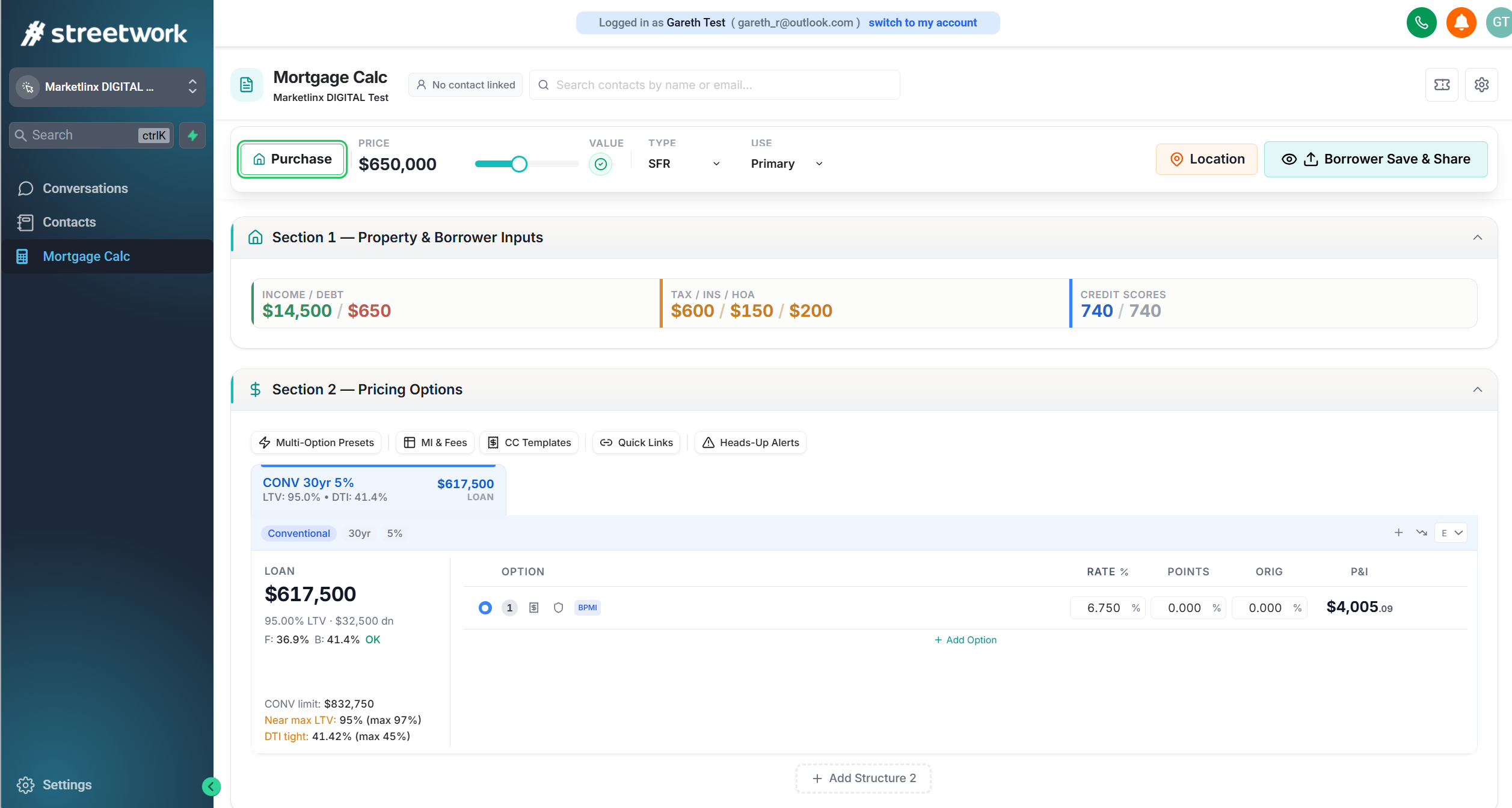
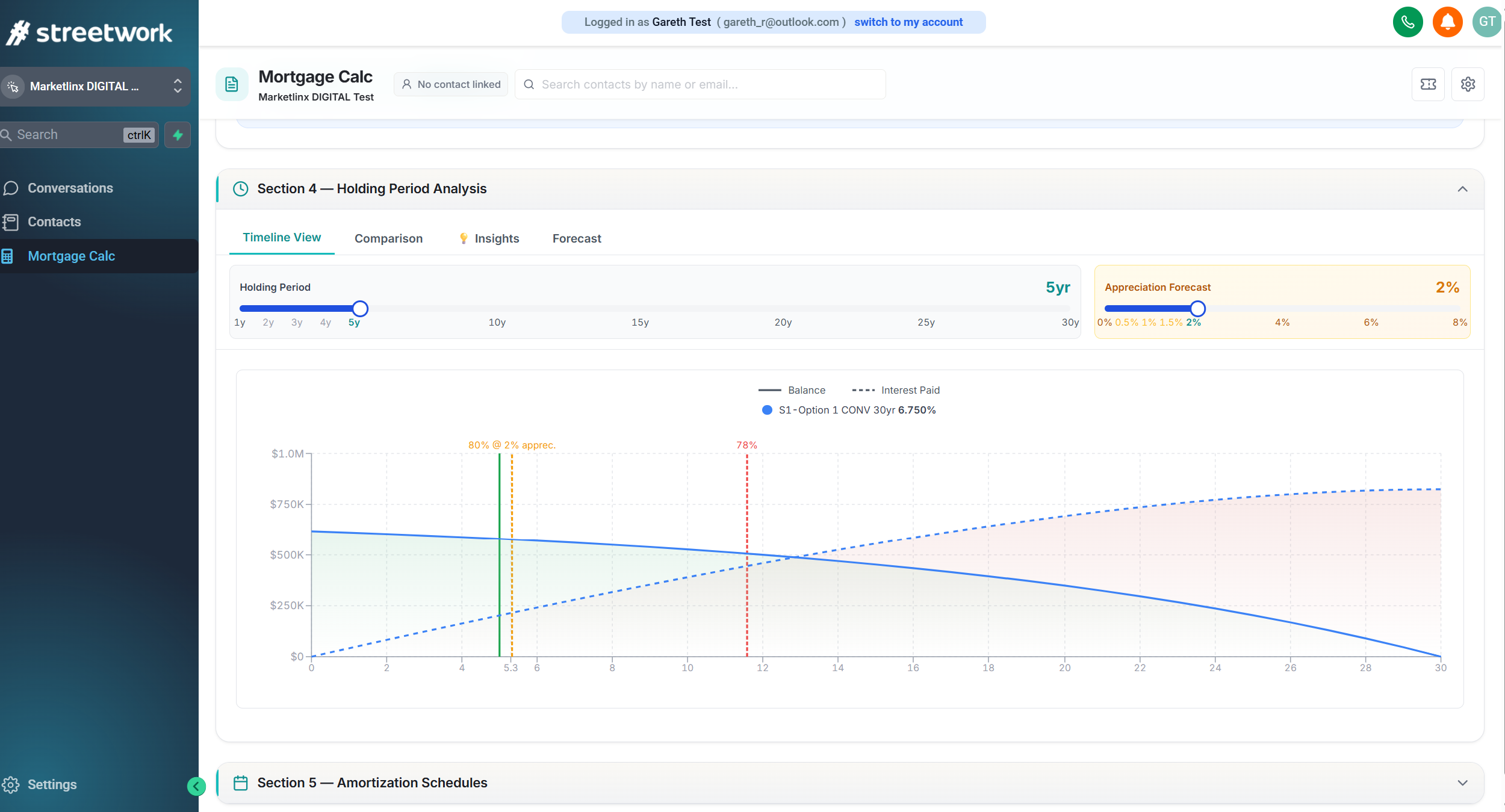
Mortgage Calc, built into HighLevel
A full loan-structuring tool that lives inside the CRM as a Marketplace app, shown here in a white-labelled account. Borrower inputs, multi-option pricing, holding period analysis and amortisation schedules, every scenario linked to the contact record and shareable with the borrower.
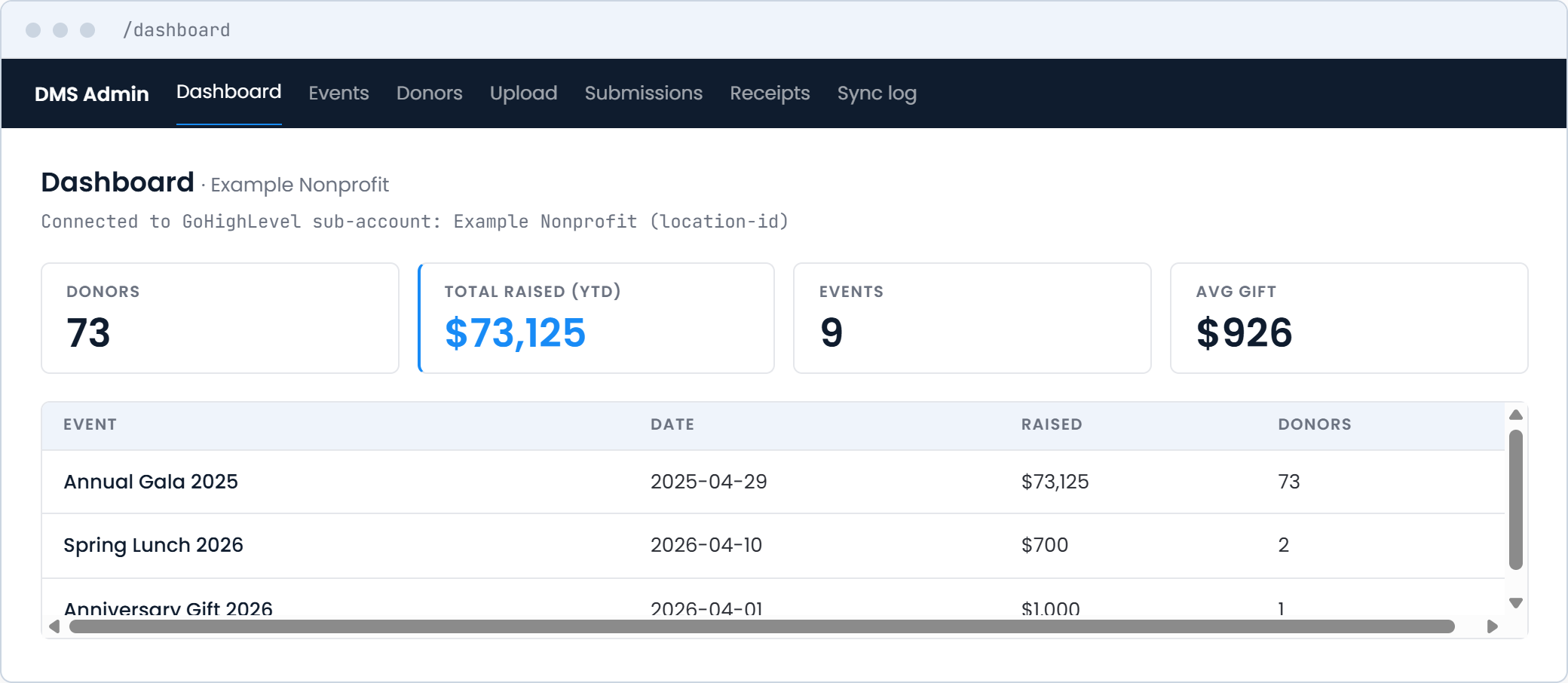
Donor Management System
Built for C3 Consulting and synced to HighLevel: donors, events, bulk imports, IRS-compliant tax receipts and a self-serve donor portal. Built because the sector's off-the-shelf options price small organisations out. The full breakdown is below.
AI coding tools are brilliant at the first 80 per cent. Then the app needs real OAuth instead of a hardcoded key, a database that survives a restart, error handling, rate limits, and hosting you own. That last 20 per cent is where prototypes die, and it's work I do every week.
I refactor what the AI wrote, secure it, wire it to HighLevel or your backend properly, and hand it back deployed, documented and yours.
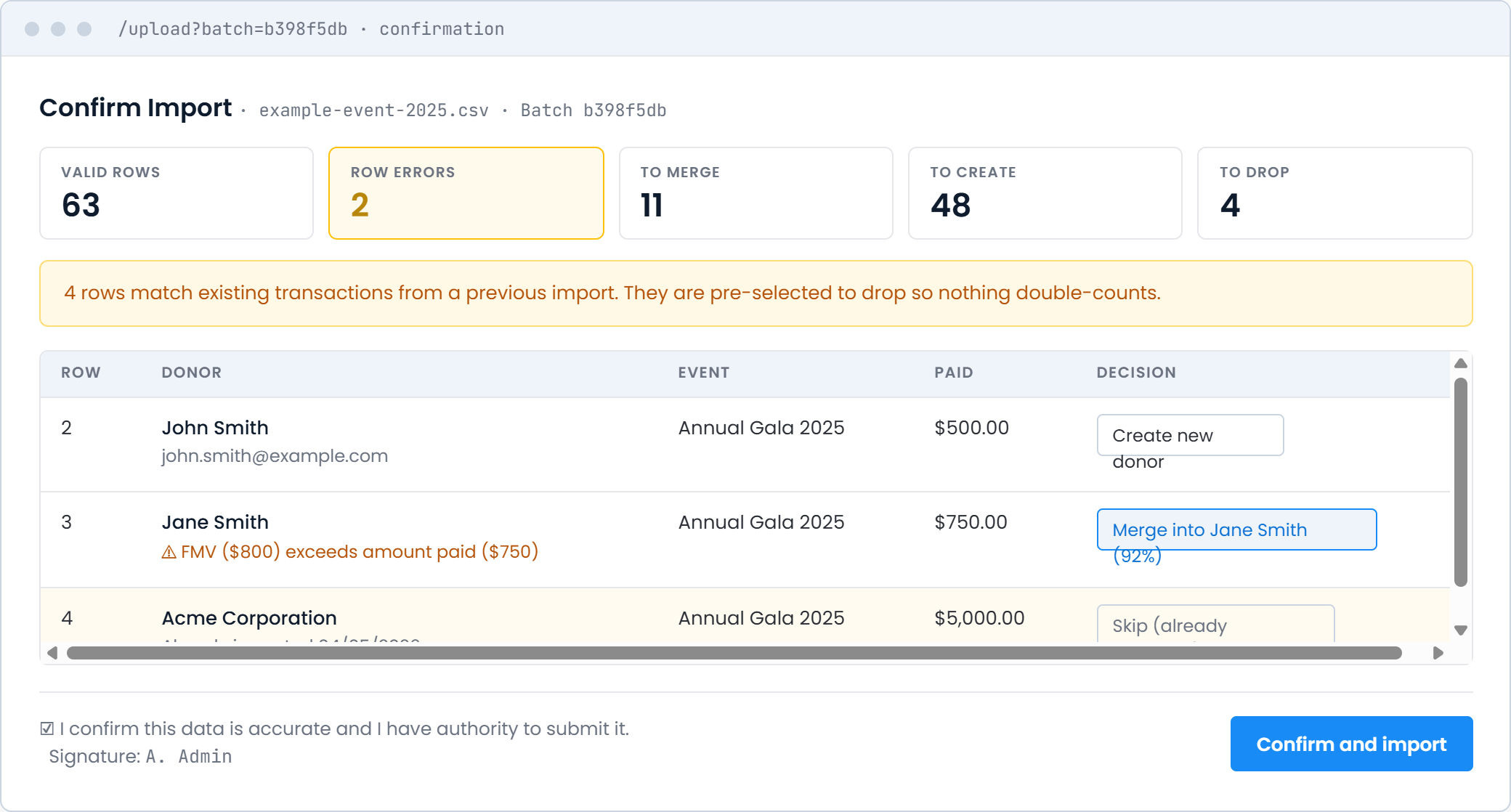
Nonprofits run on event exports, cheques in the post, and volunteers doing data entry. The DMS is built around that reality: nothing writes to the database until a human has reviewed it and signed, and everything it does is logged. It runs alongside the nonprofit's HighLevel account and keeps the CRM in step with the giving record.
A five-stage import pipeline
Every upload, whether one cheque or a 2,000-row event export, goes through parse, validate, in-batch dedup, cross-batch dedup and a signed confirmation screen. Nothing double-counts, and nothing imports without a name on it.
Smart matching and mapping
Fuzzy donor matching attaches gifts to existing records above 85 per cent confidence and asks first between 65 and 85. Built-in header presets read Greater Giving and OneCause exports as they come, including split and concatenated name columns.
IRS-compliant tax receipts
Per-donor, per-tax-year, three-section PDFs with deductibility worked out per transaction type. Finalised receipts lock at database level; corrections issue a superseding receipt with the full audit trail preserved.
A self-serve donor portal
Donors sign in with a one-time code, see their lifetime and year-to-date giving, download receipts, and submit gifts that are missing from their history into a review queue an administrator approves or rejects, with notes.
HighLevel sync, fully logged
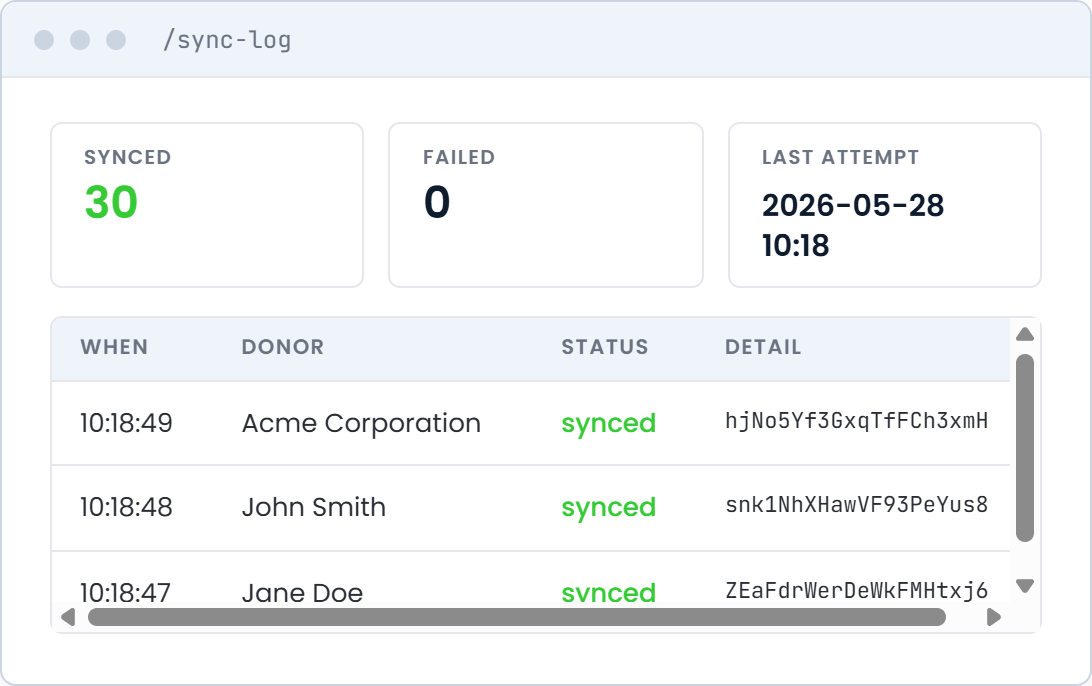
Donor aggregates push to custom fields on the HighLevel contact, one way, with every attempt logged: successes, failures, the exact error and automatic retries on rate limits. Even the login codes deliver through the nonprofit's own HighLevel channel.
Built for how nonprofits work
Precomputed dashboards that load in under a second, year-on-year event comparisons, donor tiers, QuickBooks reconciliation guidance, and in-app help on every screen that needs it.
The dashboard, reading precomputed aggregates. The header always names the connected HighLevel sub-account.
The confirmation screen. Every row, flag and match candidate shown before anyone signs.
The HighLevel sync log. Every push recorded, every failure explained.
Screens recreated from the live product, since the real ones hold client data.
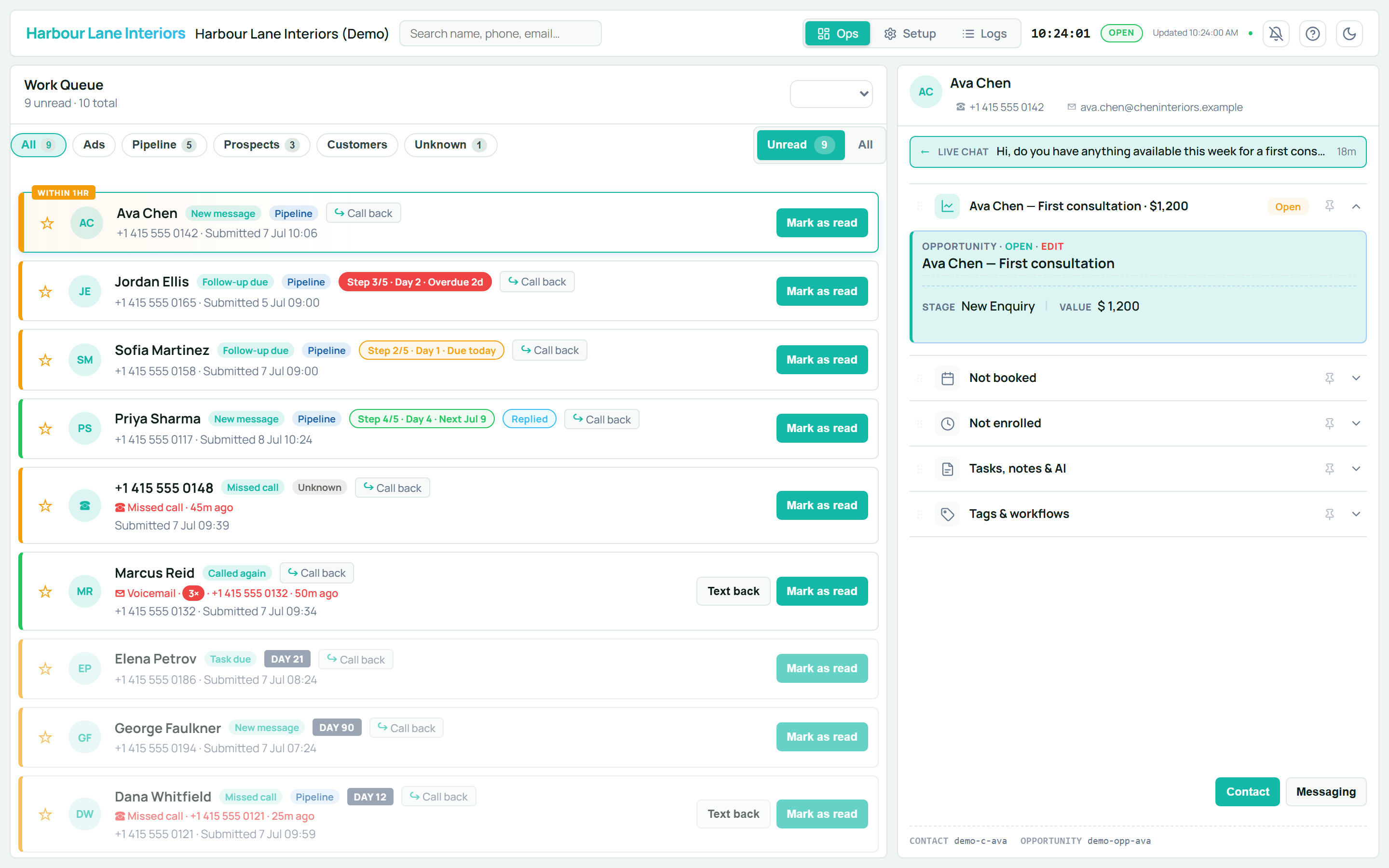
Front Desk Assist: the same thinking, pointed at the front desk
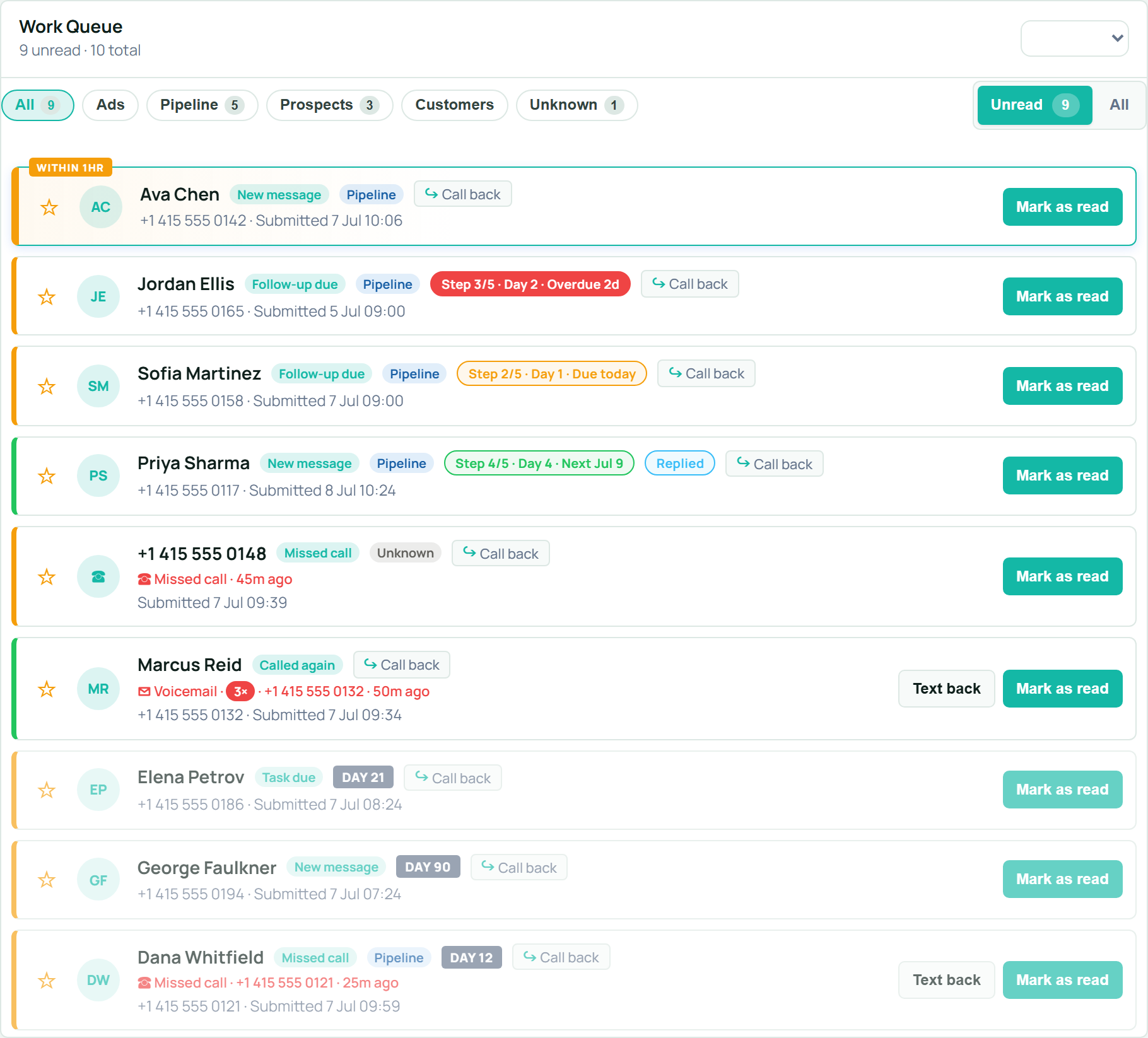
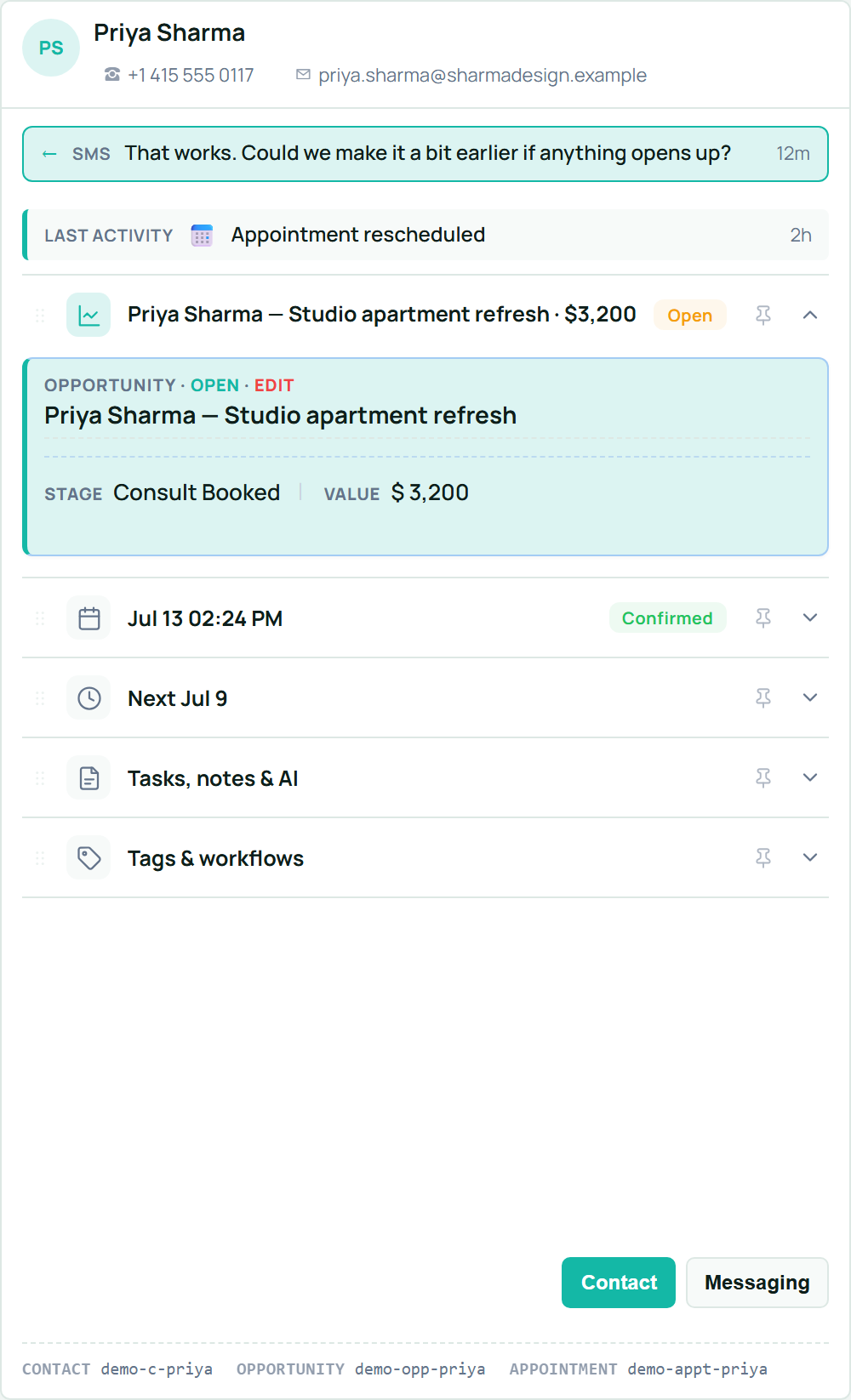
Front Desk Assist is a follow-up workbench that lives inside HighLevel. It watches the sub-account for the things a front desk must not miss, missed calls, unread messages, new leads inside the golden hour, follow-up steps falling due and appointments needing action, and merges them into one inbox the team clears to zero, most urgent card first.
A human is in charge
The dashboard says who to contact, when and why, and pre-writes the message. Nothing sends until a person reviews it and presses Send, with one deliberate, admin-controlled exception for appointment confirmations.
An inbox that's safe to clear
Marking a card read is never permanent: it returns by itself the moment the person needs a human again, with a chip saying why. Repeat callers group into one card; unreachable contacts sink but never vanish.
Follow-up on rails
Up to fifteen scheduled steps with per-step message copy that pre-fills the composer, AI drafting in the business's own voice, and schedules that stop themselves when the appointment books or the deal closes.
Why it's like the DMS
Same architecture rules, different job. A human signs off before anything irreversible happens, permissions are enforced server-side rather than by hiding buttons, duplicate events can't double-send, and every send or skip is recorded for audit. White-label ready, so agencies run it under their own brand.
The operations view: work queue left, everything about the selected contact right.
The unread queue. Every card carries a chip saying why it needs a human right now.
The contact pane: last message, opportunity, appointment and follow-up step in one column.
The work in detail
What each of these actually involves
Service pages tend to describe outcomes and leave out the work. Here is the other version: what gets built, what it costs you in decisions rather than money, and where each one tends to go wrong when somebody else has done it.
Marketplace app development
01 / 08
A HighLevel Marketplace app is a real piece of software: an OAuth client that agencies and sub-accounts install, a backend that holds tokens and refreshes them before they expire, webhook endpoints that survive being called twice, and a user interface that loads inside the CRM as though it were part of the platform. The install flow matters as much as the feature. An app that breaks on uninstall, or that leaks one client's data into another's view because the location id was trusted from the front end, will fail review and deserve to.
The builds I take on usually start as an internal tool somebody is running by hand across twenty clients. Turning that into an app changes the economics: one codebase, per-location OAuth, and a product that can be licensed rather than delivered. Front Desk Assist and the provisioning console both started that way. Expect decisions about scopes, about what happens to data when an account uninstalls, and about how much of the interface belongs in HighLevel versus a separate dashboard.
Voice AI that belongs on a real phone line
02 / 08
A voice demo is easy. A voice agent on your main business number, at nine on a Monday, is a different discipline. It needs to know your opening hours, your services, your prices or your refusal to quote them, and the specific things it must never say. It needs to book into the same calendar your staff use, with the same buffers. It needs an escalation path: the caller who says "I want to speak to someone" gets a person, quickly, and the agent leaves a note explaining what was already discussed so the human does not start from zero.
The deployment work is call-flow design first and prompt engineering second. Which calls should the agent take, which should ring through, what happens out of hours, what happens when the caller is an existing customer with an open job. Then recordings and transcripts land against the contact record so you can audit what was said, and the whole thing gets tested against real recordings before it answers a real customer.
MCP servers and API integration
03 / 08
Integration is where most HighLevel projects meet their limit, because it is the point at which the platform has to agree with a system that was never designed to talk to it: a loan origination system, a practice management tool, an ERP, a legacy database somebody's father-in-law wrote. The API work itself is rarely the hard part. The hard part is deciding which system is the source of truth for each field, what happens when they disagree, and how you find out.
Model Context Protocol servers are the newer half of this. An MCP server gives an AI agent typed, permissioned tools instead of a scraped screen: look up this contact, check this availability, create this opportunity, and nothing else. It is the difference between an agent that can act on your systems safely and one that is guessing. Almost nobody in this market offers it as a service, which is exactly why I do.
CRM build and clean-up
04 / 08
Most accounts I open have grown rather than been designed. Three pipelines that overlap, custom fields with names like "Notes 2", stages nobody can define, and half the reporting done in a spreadsheet because the CRM's numbers are not trusted. The work is not technical so much as forensic: establishing what the business actually does, then making the CRM agree with it.
A rebuilt account has one pipeline per real sales motion, stages with entry and exit criteria a new starter could apply, custom fields that are used by something, lifecycle stages that say who owns a contact right now, and reporting that the owner will actually open. It also has documentation, because an undocumented rebuild is the same trap one iteration later.
Lifecycle automation
05 / 08
Automation problems are almost never about the individual workflow. They are about the interaction between eleven workflows written at different times by different people, each reasonable alone. The symptom is the same everywhere: one contact receiving three messages in an hour, a lead sitting in a nurture sequence months after they became a customer, or a follow-up that stops the moment someone replies, which is exactly when it should escalate.
Designing the whole lifecycle as one system means deciding what a contact's state is at any moment, which workflow owns that state, and what the exit conditions are. Then the messages themselves get attention: enough touches to be persistent, few enough to remain welcome, with sending windows that respect the recipient's timezone rather than yours.
White-label SaaS and provisioning
06 / 08
SaaS mode turns an agency from a service business into a software business, but only if new accounts can be created reliably. The toggle is the easy part. The product is everything around it: which plan a client is on, what that plan includes, how rebilling handles usage, what a new sub-account looks like on day one, and who fixes it when the snapshot has drifted from what you actually sell.
Provisioning is where this becomes engineering. A console that proposes around a hundred values per location, stages them for review and applies them in one logged operation turns onboarding from a fortnight of clicking into an afternoon, and makes every account identical to the last. That consistency is what makes support scalable: when every account is the same shape, a fix is a fix rather than an investigation.
Self-hosted infrastructure
07 / 08
Every serious HighLevel build eventually has something running beside it: middleware, a database, an automation engine, a webhook receiver. Running that on a metered platform is fine until volume arrives and the bill scales with success. Running it on infrastructure you own means predictable cost and, more importantly, control over the failure modes.
In practice that is a provisioned server, a private network so services are not exposed to the open internet, a database with backups that have actually been restored at least once, monitoring that tells you a webhook endpoint has gone quiet before a client does, and deployment that does not depend on one person's laptop. None of this is exotic. It is simply the difference between a system and a script.
Retained development
08 / 08
Once a platform is load-bearing, the question stops being what to build and becomes who is watching. HighLevel ships weekly. APIs change. A scope gets deprecated, a webhook payload gains a field, a feature you depended on becomes a paid add-on. On a retainer that is my problem rather than yours: I read the release notes, I know your account, and the fix happens before you notice.
The other half is standing capacity. Most operators have a list of small improvements that never justify a project on their own. A retainer works through that list monthly, in priority order, without a quote for each one. It also means when something does break at an awkward moment, the person picking it up already knows how the account is built. If you want that watching to continue after a project, the ongoing partnership is how the monthly block is agreed.
Productised build
AI for any business, installed as one snapshot
This is a snapshot I built on the back of HighLevel's Summer of AI, leveraging the managed agents they call super agents. It fits any business that wants the repetitive work automated: a workspace where every enquiry lands in one place, an assistant answers first, and the record-keeping happens without anyone clicking. You supply the facts about your business. Nothing invents a price, a service area or an opening time you did not write down.
The talking layer
A Qualifier that handles website chat, text, WhatsApp and social: it asks your qualifying questions in your business voice, offers the first appointment, and hands to a human the moment it is unsure. Alongside it, Business Voice answers inbound calls and takes after-hours voicemail once your number is attached.
The back-office crew
Five agents that fire on events rather than schedules. Intake opens the record and scores fit. Enquiry Handler makes the first response. Triage decides whether a transcript is even a real enquiry. Booking confirms and notifies. Attendance runs reminders, no-show recovery and rebooking. Behind them, managed nurture agents work the long game: long term lead nurture and re-engagement campaigns that quietly wake dormant leads and past customers.
Where a human takes over
Four conditions, defined up front: they ask for a person, the assistant cannot answer from the facts you supplied, they are a poor fit or it is a complaint needing judgement, or the call needs transferring to a named number. Everything else runs quietly, and you only get pinged when it matters.
Stage
What the customer sees
Which assistant acts
When you hear about it
1 · Enquiry
Customer seesForm, website chat, or a call once connected.
Assistant actingQualifier or Business Voice. Intake opens the record.
You hear about itNothing yet. The system is working.
2 · Qualify
Customer seesQualifying questions in your business voice.
You hear about itOnly for "I want a person" or unsafe cases.
3 · Book
Customer seesOffered a first appointment. Confirmation sent.
Assistant actingBooking confirms and logs the appointment.
You hear about itBooking notification to named staff.
4 · Show or no-show
Customer seesReminders, and a rebook if the visit is missed.
Assistant actingAttendance runs reminders and no-show recovery.
You hear about itMissed-appointment alert to named staff.
5 · Nurture
Customer seesUseful check-ins on the channel they used, spaced over weeks and months, never spammy.
Assistant actingManaged nurture agents run long term follow-up until the lead is ready or opts out.
You hear about itA hand-back alert the moment a reply shows real intent.
6 · Re-engage
Customer seesAn occasional reason to come back: a new offer, a reminder, a check-in.
Assistant actingRe-engagement campaigns wake dormant leads and past customers on a schedule.
You hear about itA warm-lead alert when someone bites, with the full history attached.
Every client gets a written platform overview covering exactly this: what is in the account, who speaks to customers on which channel, and what you supply versus what I configure. Ask for it on the call.
Voice AI, in numbers
The phone problem is measured. So is the fix
Six numbers, each with its source attached. The first two are the problem, the other four are why an AI answering layer stopped being a gimmick. Where a study is old or small I say so, because a stat without its source is just a sales line.
62.2%
of calls to small businesses go unanswered
411 Locals field study: 85 businesses across 58 industries. Only 37.8% of calls reached a person. It dates from 2016 and is still the only real field count, so treat it as directional.
42%
of callers will leave a voicemail. The rest are simply gone
CallRail survey of 1,000 US consumers, 2025. A quarter switch to chat instead, and the majority move on, which is why voicemail is not a safety net.
4.2%
abandonment when the call is answered inside 2 seconds
Against 23.7% after 30 seconds on hold. ContactBabel contact-centre research, 2025. Answering instantly is most of the job, and instantly is the one thing software is guaranteed to be.
28%
of inbound calls at Wyndham Hotels are handled by AI agents
With handle time down 30 to 50%. PwC case work, 2025. Not a startup demo: a 9,000-property hotel group running it in production.
72%
customer satisfaction with AI voice agents, up from 53% in 2022
Zendesk CX Trends research. The complaint used to be that callers hated the robot. Measured satisfaction says that era is ending.
$80bn
of contact-centre labour cost removed by conversational AI in 2026
Gartner's projection for this year alone. The technology your callers meet is the same class of system the enterprises are betting on.
The Voice AI I deploy inside HighLevel accounts exists for the first two numbers: answer every call in seconds, and stop trusting a voicemail box nobody speaks to. The other four are why it finally works well enough to be given your phone line.
Ad Manager: Meta and Google ads, run from inside the CRM
The latest releases of HighLevel's Ad Manager are genuinely good, and I don't say that about many features on launch. Campaigns for Meta and Google are built, launched and reported inside the sub-account, which quietly fixes the oldest problem in paid traffic: the wall between the ad platform and the CRM that leads used to fall down.
Leads land in the CRM instantly
Lead form submissions arrive as contacts in seconds, with source attribution attached, and the follow-up workflow fires immediately. No Zapier in the middle, no sync that silently stopped on Tuesday, and speed to lead starts at zero minutes.
The feedback loop actually closes
Real outcomes flow back to the ad platforms through the Conversions API, so Meta and Google optimise toward the leads that booked and bought, not the ones that merely clicked. Lead quality improves because the algorithm finally knows what a good lead looks like to you.
One screen per client
Budgets, spend, cost per lead and cost per booked appointment sit in the same account as the pipeline they feed, and agencies get white-label reporting per sub-account. The awkward "the ad report says one thing, the CRM says another" meeting stops happening.
The compliance is handled properly
Special Ad Category rules for housing, credit and employment, consent language on forms, and tracking that holds up as third-party cookies fade. The boring parts, which is precisely where accounts get banned when they're skipped.
I hold HighLevel's Meta Ads and Paid Ads skills badges, and I wire Ad Manager into the rest of the build: the forms, the CAPI feedback, the follow-up, and the reporting your clients actually read.
A lead is a person who wanted something at the moment they enquired. Every minute after that, the want cools, the tab closes, and a competitor answers. The research on this is old, famous and still ignored by almost everyone, which is why answering fast is the cheapest advantage left in sales.
21×
more likely to qualify the lead
calling within 5 minutes versus 30 minutes. The Lead Response Management study, and it has replicated ever since.
78%
of buyers choose the first responder
not the best, not the cheapest: the first business that actually answered them.
42h
the average company's response time
Harvard Business Review audited 2,241 companies. Under 37% replied within an hour. That's the bar you're clearing.
Odds of reaching the lead, by how long you wait
5 minutes
the golden window
10 minutes
30 minutes
Next day
Indicative decay curve from the lead-response research: the odds of making contact collapse within the first half hour and never recover.
This is why Front Desk Assist exists, and why its queue puts a WITHIN 1HR ribbon on brand-new leads and floats them to the top. Speed to lead is not a talent. It is a system: the missed call texts back in seconds, the new enquiry is the next card on the screen, and the follow-up schedule catches whoever slipped through the first hour.
Nobody writes about this, because writing about it requires having broken things at volume. If you recognise your account in any of these, it is fixable, and knowing the name of the problem is most of the diagnosis.
1. Webhooks that fire twice
Webhook delivery is at-least-once, not exactly-once. Any endpoint that creates a record, sends a message or takes a payment without checking whether it has already seen that event id will eventually do it twice. The fix is idempotency keys and a processed-events table, not hoping.
2. OAuth tokens nobody refreshes
Access tokens expire. Refresh tokens rotate. An integration built with a token pasted into a config file works beautifully for a few weeks and then dies silently, usually while the person who built it is on holiday. Refresh has to be automatic, and failures have to alert someone.
3. Rate limits treated as errors
Every API has limits, and hitting them is normal under load, not exceptional. Code that throws on a 429 and moves on drops work permanently. Code that backs off, retries with jitter and resumes where it stopped is the difference between a bulk operation that completes and one that half-completes without telling you.
4. Duplicate contacts from three doors
A form, an import and an integration each create contacts by slightly different rules, and within a year the same person exists three times with a third of their history each. Deduplication needs a defined identity rule, applied at every entry point, before the data arrives rather than as an annual clean-up.
5. Snapshot drift
The snapshot you onboard clients with stops matching what you actually sell about four months in. New accounts get the old shape, old accounts never get the improvements, and support becomes archaeology. Provisioning from a recorded, versioned definition solves this. Cloning by hand does not.
6. A2P rejections at launch
Messaging registration is the most common reason a launch date slips, and it is entirely predictable: mismatched business details, a website with no visible opt-in language, or sample messages that do not match what the campaign actually sends. Started early it is paperwork. Started late it is a fortnight of silence.
7. Timezone arithmetic done by hand
Appointment reminders an hour out, campaigns landing at 3am, follow-ups marked overdue when they are not. Almost always a workflow doing its own offset maths instead of using the account's timezone, and almost always discovered the weekend the clocks change.
8. Race conditions between workflows
Two workflows triggered by the same event, both writing the same field, produce a result that depends on which ran first. Behaviour looks random and reproduces only sometimes, which is why it survives so long. The cure is a single owner per field and per state transition.
9. No record of what changed
The one that makes all the others expensive. When nobody can say what was altered, when, or by whom, every incident starts with a week of reconstruction. Logged, reversible changes are not bureaucracy: they are what turns a mystery into a five-minute answer.
Migration
Moving onto HighLevel without losing a month of pipeline
Migrations fail in a predictable way. Everything is exported, everything is imported, everyone switches on Monday, and by Wednesday nobody trusts the data so the team quietly goes back to the spreadsheet. The way to avoid that is to migrate in the order the business can absorb, and to keep the old system readable until the new one has proved itself.
The order that works
Contacts and companies first, with the field mapping proved on a few hundred records before the full set moves. Then open opportunities, because live deals are what the team will check first and what they must be able to trust immediately. Then history: notes, calls, past transactions, whatever the business genuinely refers back to, which is usually far less than people claim.
Only after that do calendars, phone numbers and messaging move, because those are the parts customers notice. Number porting in particular has a lead time and cannot be rushed on the day. Automations come last, after the manual process has been run inside the new system for a week or two, because automating a process nobody has performed by hand is how you industrialise a mistake.
What to decide before anything moves
•What makes a contact unique, so imports cannot create duplicates
•Which system is the source of truth during the overlap, and for which fields
•Which history genuinely needs to come across, and what stays archived and readable
•Who signs off that the data is right, and against what report
•What the rollback looks like if week one goes badly
•When A2P registration starts, which should be immediately
The one non-negotiable: nothing is deleted from the old system until the new one has run a full billing cycle. Migrations are reversible right up until somebody cancels the old subscription.
Honest comparison
When HighLevel is the wrong answer
I recommend it for most small and mid-sized operators, and I have said no to enough projects to be specific about the exceptions. A recommendation without exceptions is marketing.
Where it wins clearly
Service businesses that sell by conversation: trades, clinics, brokers, agencies, local operators with a phone that must be answered. Anyone currently paying for a CRM, an email tool, a scheduler, a phone system, a review tool and a funnel builder separately. And any agency that wants recurring software revenue rather than retainers alone.
Where it is a poor fit
Fewer cases than there used to be. Custom objects, custom fields and associations now cover most complex sales structures, so even territory and forecasting setups that once demanded an enterprise CRM can be modelled properly. The genuine exceptions left: businesses whose process is inseparable from an industry-specific system of record, and product-led software companies whose lifecycle lives in the app itself. There the incumbent platform plus integration is the right call, and I will say so.
The honest trade-off
Breadth costs depth. A specialist email platform has more sophisticated deliverability tooling; a specialist telephony platform has more call routing options. HighLevel's argument is that one shared contact record beats six best-in-class tools arguing about who owns the truth. For most operators that is correct. For some it is not.
The pace question
Weekly releases mean features arrive fast and occasionally change under you. If your organisation needs frozen, certified software with long deprecation windows, that pace is a risk rather than a benefit. It is also exactly why documented, reversible builds matter here more than on a slower platform.
Glossary
HighLevel terms, in plain English
The vocabulary is half the barrier for anyone new to the platform, and it is used loosely even by people selling services on it. These are the terms that come up on almost every call.
Agency account and sub-account
The agency account is the top level; each client, location or business unit gets a sub-account beneath it. Sub-accounts are isolated from each other, which is why "which sub-account am I in" is the first question before any bulk operation.
Snapshot
A copyable template of an account's configuration: workflows, pipelines, funnels, calendars. Useful for standardising onboarding, and the source of drift when the snapshot stops matching what you actually sell.
SaaS mode
The capability that lets an agency resell the platform under its own brand, with its own plans, pricing and rebilling. It turns the agency into a software vendor, with the support obligations that implies.
Rebilling
Charging clients for usage-based services such as SMS, calls, email and AI, usually at a markup. It only works if the numbers reconcile, which is a bookkeeping problem as much as a configuration one.
A2P 10DLC
The registration regime for application-to-person messaging on standard numbers. Carriers require the business, the brand and the campaign to be registered before messages deliver reliably. Start it on day one.
Workflow, trigger and action
A workflow is an automation: a trigger starts it, actions do things, conditions branch it. Most account problems are not a broken action but two workflows disagreeing about who owns a contact's state.
Custom fields and custom values
Fields hold data about a contact; values hold account-level constants such as a booking link or business name. Used well, they are how one message template serves every client. Used badly, they are how nobody can safely delete anything.
Pipeline, stage and opportunity
An opportunity is a potential piece of revenue moving through stages in a pipeline. Stages should describe the customer's position, not your internal admin, and each needs criteria a new starter could apply without asking.
OAuth and scopes
How an app is granted access to an account without holding a password. Scopes limit what it may touch. Per-location OAuth means an app installs against one sub-account at a time, which is what keeps client data separate.
Webhook
A message from the platform to your system saying something happened. Delivery is at-least-once and order is not guaranteed, so anything a webhook triggers must be safe to receive twice.
MCP server
A Model Context Protocol server exposes typed, permissioned tools to an AI agent: specific actions it may take, with defined inputs. It is how an agent acts on real systems without being handed the keys to everything.
Marketplace app
Software installed into a HighLevel account through the official marketplace, with its own OAuth, interface and webhooks. The route to functionality the native builders cannot reach, and to licensable products rather than one-off builds.
Fit
Who I'm right for, and who I'm not
Being specific about this saves us both a call. I would rather turn work down than take an engagement where the honest answer is that somebody cheaper would do it better.
A good fit
•Your platform is load-bearing: when the CRM stops, revenue stops
•You have inherited an account nobody documented and need it understood before it is touched
•You need something the native builders genuinely cannot do
•You are an agency wanting a product to license rather than a service to deliver by hand
•A previous build failed and you want to know why before rebuilding
Not a fit
•A snapshot install or a template drop, where a marketplace freelancer is faster and cheaper
•Paid media management, brand design or copywriting as the main deliverable
•A build with no access to the people who understand the business process
•Work that has to be done without documentation or a record of changes
"Nobody has ever rung me because everything was working."
Which is fine. Ring me with the thing that isn't, and keep the audit either way.
The questions I always get
What is HighLevel (GoHighLevel)?
HighLevel, often written GoHighLevel, is an all-in-one CRM and business operations platform. It combines a CRM, pipelines, marketing automation, funnels and websites, calendars and booking, two-way SMS and email, phone calls, reviews, payments and AI agents in one system, and agencies can white-label the whole platform under their own brand.
Why do you call HighLevel the best business operations platform?
Because it replaces a stack of six or seven subscriptions with one platform where everything shares a single contact record, it has a real API and Marketplace for developers to extend it, AI is built into the platform rather than bolted on, and SaaS mode lets an agency resell the whole thing under its own brand. Nothing else in its price range does all four.
Is the audit really free?
Yes. You give me access, I go through the account, and you get a written list back. If you take it away and fix it yourself, that's a fine outcome.
Can you fix a build someone else broke?
Most of my work arrives that way: half-built pipelines, workflows fighting each other, no documentation. That's the normal starting point, not a problem.
Do I keep my account and my data?
Always. I work inside your account, not a copy. Changes are proposed before they're made, logged when they're made, and reversible afterwards.
What does it cost if I go ahead?
Small fixes get handled on the call. Larger work is a fixed project price, quoted after the free audit. If a cheaper option is genuinely better, I'll say so.
How quickly can you look at it?
Usually within two working days of getting access. Anything urgent goes to the front, so say so in the form.
Do you work with agencies?
Yes, and much of it is white-label. I stay behind your brand unless you want me on the client call.
Where the work happens
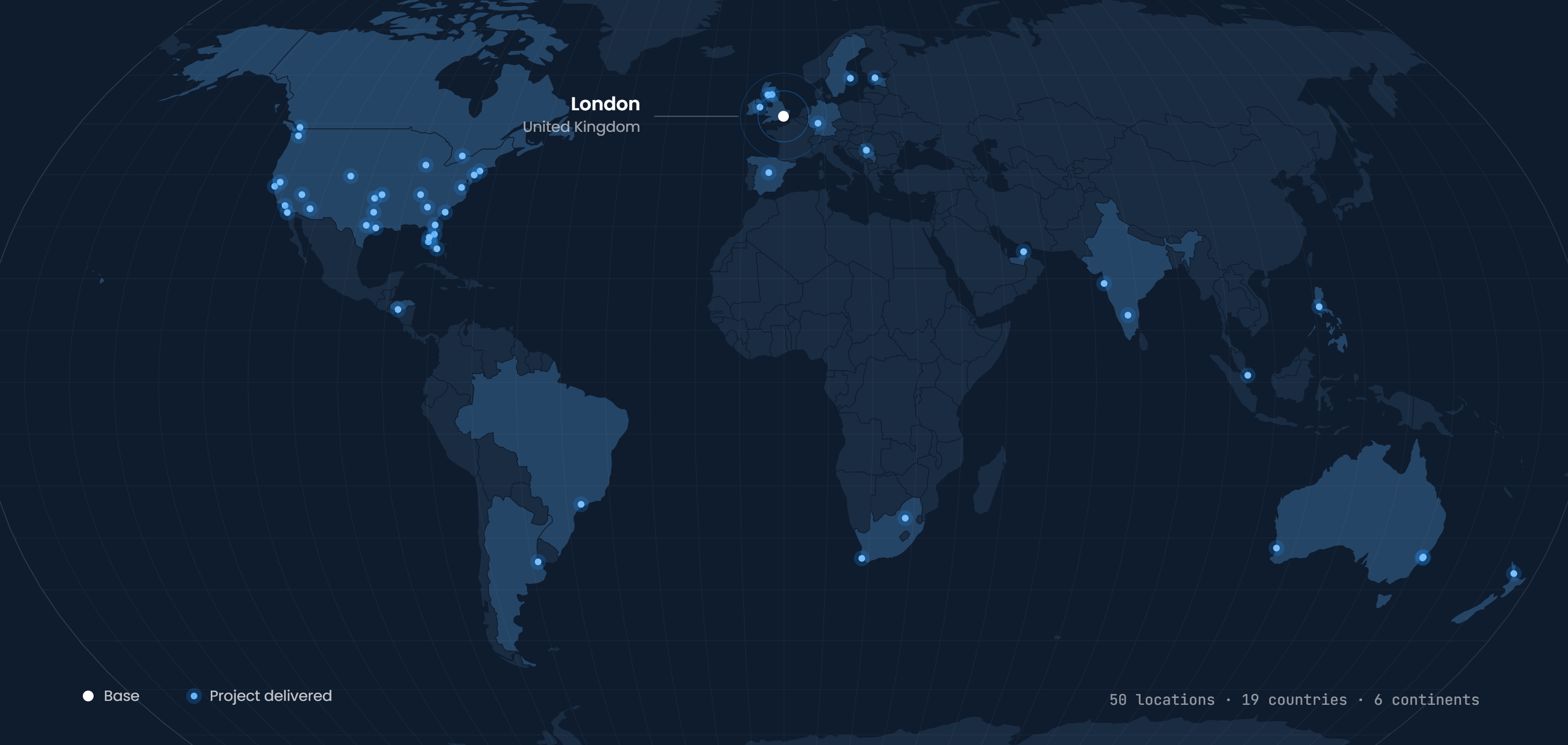
Based in London. Delivered wherever you are.
Everything on this page is delivered remotely, and most of my clients are not in the UK. Calls get scheduled against your working hours rather than mine, urgent breakage doesn't wait for a timezone, and the documentation means the work survives the distance.
50 locations · 19 countries · 6 continents
Worth browsing
The Level Up Marketplace: see what already exists before you commission anything
Level Up Marketplace is a curated marketplace built by fellow HighLevel developer partners: apps, snapshots, integrations and training from people who build on the platform for a living. Alongside HighLevel's own App Marketplace, it is the best browse in the ecosystem for finding out whether the thing you need already exists.
That might sound like an odd thing for a developer to promote. It isn't. Half of good scoping is knowing what not to build, and an off-the-shelf app at marketplace prices beats a custom build for any problem that isn't specific to your business. When a client's problem is already solved on a marketplace, pointing at it is the honest answer, and it's why the custom work I do take on is the work that genuinely has no shelf to buy from.
We sponsor LUM under AgencyPRO.tools, the apps brand from Marketlinx DIGITAL. If you found the influencer profile first, that page is the hub for Marketplace apps, white-label products and custom builds.
How I'd use it
Search it before commissioning anything custom. If it exists, buy it.
Read the reviews the way you'd read mine: at source, recent first.
Check what an app touches before installing: scopes are the small print.
If nothing fits, that's the moment for custom, and you'll scope it better for having looked.
Send me the account, or thirty minutes on the phone. Either way you leave with a written view of what's broken and what it takes to fix, whoever fixes it.




 Anthropic
 OpenAI
 Perplexity
 WhatsApp
 Meta
Meta Twilio
 Stripe
 Google Calendar
 n8n
n8n Make.com
 WordPress