
At a glance
What the operator reviews, and what the console is allowed to touch.
~100
Values proposed
Per location, each with provenance
49
Updates in one push
Into a live sub-account, all reversible
10
Settings on the allowlist
Everything else discarded
4
Typed confirmations
Checked server-side, not in the browser
The problem
Days of typing, every single time
If you run a repeatable HighLevel build across a lot of sub-accounts, the build is identical and the content is not. Somebody sits with the client's website open in one tab and HighLevel in the other and types about a hundred custom values: names, services, prices, hours, colours, fonts, policies, and copy that has to sound like this specific business.
A new location gets submitted. The console researches it automatically and comes back with a proposed value for every field in the build. The operator reviews the whole thing on one screen, corrects what needs correcting, then types a confirmation phrase to push it live.
What got built
A review screen that shows its working
The console is a Marketplace-shaped app on HighLevel API v3. It does not invent fields. It proposes values against fields that already exist, each carrying a source and a confidence figure, marked agreed or contested so the operator reviews provenance rather than re-deriving every row.
How it works
The merge is the actual work
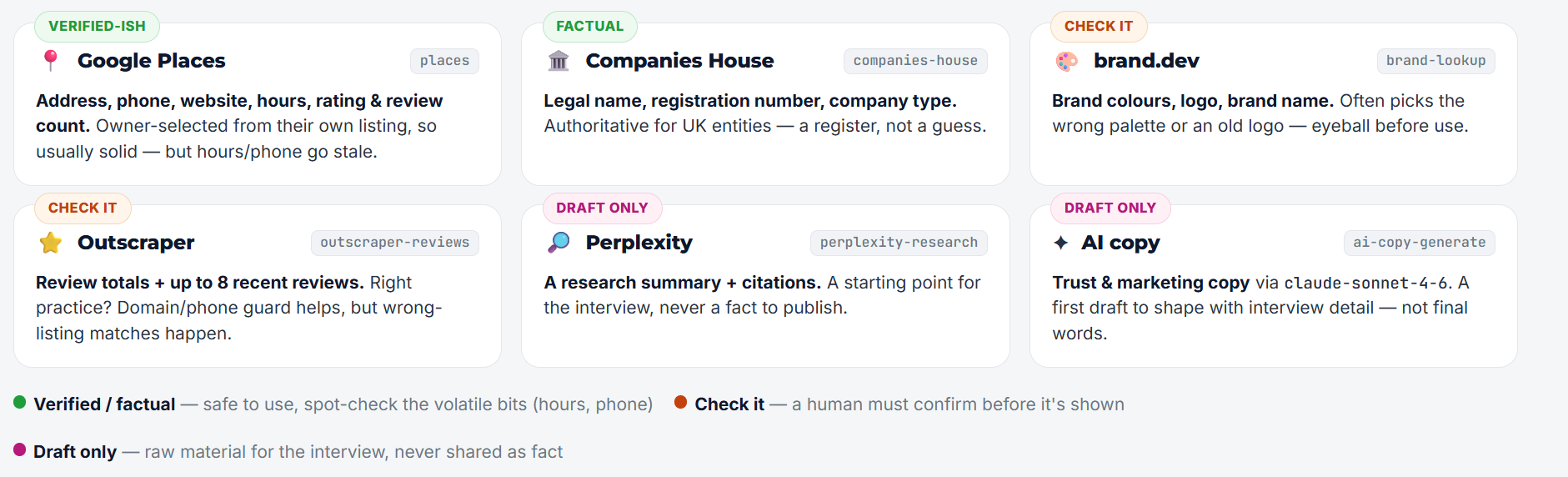
A stack of narrow sources, each genuinely good at one thing, rather than one API asked for a profile. The legend on this page names the six the console actually scores: Google Places, Companies House, brand.dev, Outscraper, Perplexity, and a first-pass AI copy draft.
Fan out
Google Places for address, hours and rating. Companies House for the legal name. brand.dev for colours and logo, which still need an eyeball. Outscraper for recent reviews. Perplexity and AI copy as draft-only input for the interview, never as published fact.
Reconcile
Sources disagree. The website gives one set of opening hours; Google gives another. The trading name differs from the registered name. The fonts on the live site differ from the ones in the brand guidelines.
Score
Every field carries its source and a confidence figure, so attention goes where it is contested.
Confirm
Nothing pushes without a typed phrase, checked on the server.
Onboarding is a staged process, not a single event, so the console sits inside an admin portal that tracks every location through those stages. You can see what has been done, what is waiting, and where each pending client has got to, without going into HighLevel at all.
Some information is not on a website and never will be. So there is a managed client interview: you run the call, it is recorded and transcribed, and the transcript populates custom values and other areas of the CRM directly. The discovery call stops being something you then transcribe by hand. It becomes the input.
Nothing arrives as a bare value. The operator is not re-deriving every field from scratch. They scan provenance, accept the rows where independent sources agree, and spend their actual attention on the handful the system has flagged as contested or thin. One go-live pushed 49 updates into a live sub-account in a single operation. Every one was logged. Every one was reversible.
Honesty
What it did not do
It cannot create fields. If a field does not exist, it is reported and skipped. It cannot touch mail settings, phone configuration or snapshots. Nothing goes live on its own. A person confirms every deploy.
Update, never create
If a field does not exist, it is reported and skipped. The tool cannot overrule a human decision.
Fixed allowlist
Ten location settings, decided in advance. Mail, phone and snapshots cannot be reached.
Typed confirmation
Four actions, four phrases, verified server-side.
Logged with old value
Undo is one button, not an afternoon of reconstruction.
The system is not trying to be right. It is trying to be transparent about how confident it is, which is a much more useful thing for it to be.
Related
Services and sibling write-ups
This is Marketplace app work on HighLevel API v3, and it is the machinery behind white-label SaaS provisioning. Sibling write-ups: the platform layer, API onboarding, FrontDesk Assist. Product surface: AgencyPRO.tools.